
Year Seven have recently completed their study of Shakespeare’s sonnets. Their work involved analysing the story arc of Shakespeare’s 1609 book of 154 sonnets, that covered a poet imploring a beautiful man to have children to preserve that beauty, love for a swarthy lady, and the poet’s feeling of jealousy and betrayal when these two people meet up and have an affair.
Particular sonnets were studied for their structure and form, as well as their content, including Sonnet 2 “When forty winters have besieged thy brow”, Sonnet 17 “Who will believe my verse in time to come?”, Sonnet 18 “Shall I compare thee to a summer’s day?”, Sonnet 20 “A woman’s face with nature’s own hand painted”, Sonnet 29 “When in disgrace with fortune and men’s eyes”, Sonnet 118 “Let me not to the marriage of true minds admit impediments”, and Sonnet 130 “My mistress’ eyes are nothing like the sun”.
After that, each student selected a sonnet of their choosing, and presented it to the rest of the class, explaining its structure, meaning, and use of poetical devices.

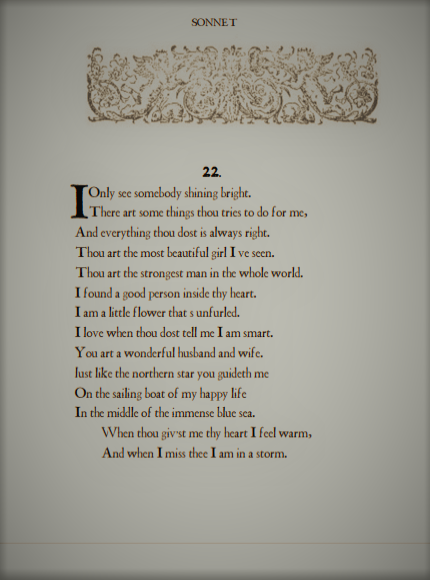
After having completed their analyses, the students then turned their hands to writing their own sonnets. This meant meeting the criteria that a Shakespearean sonnet demands: fourteen lines of iambic pentameter, made of alternating rhyme in three quatrains, rounded off with a heroic couplet.
Here below is an example of Leone’s, which he wrote about his parents:
They have now begun studying Romeo and Juliet which, as coincidence would have it, begins with a sonnet – something not lost on our latest scholars of the Bard.